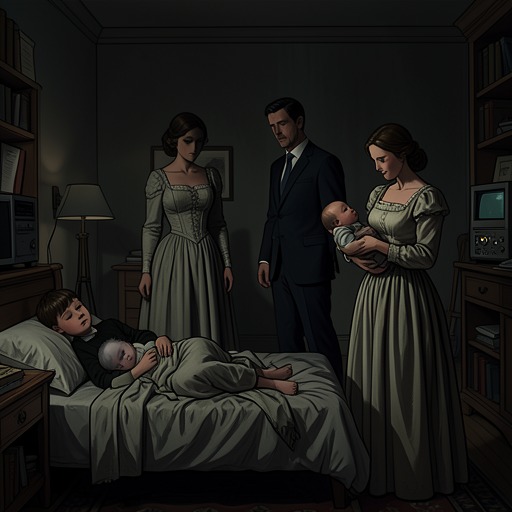
Cissie Burns’s pregnancy
Mothering SundayCissie Burns’s pregnancy transforms a concealed abuse within the workhouse into a test of whether its authorities will protect her or punish her. Albert Pinnegar has forced himself on her, but instead of receiving meaningful support, Cissie faces secrecy, the threat of confinement, and separation from the child she hopes to love. Her experience also gives Sunday Small a pattern she later recognizes when Daisy Branning becomes pregnant after Pinnegar assaults her.
Background and discovery
The workhouse’s divisions kept men and women, boys and girls apart, while residents were assigned labor according to their position and ability. Women and girls worked in the sewing room, kitchens, or laundry; Sunday Small knew that the separation could devastate families. It did not, however, prevent Albert Pinnegar from exploiting his authority over girls. He repeatedly summoned Cissie Burns to his office under the pretext that his floor needed mopping, and Miss Frost, who had seen his interest in the girls before, did not intervene. Sunday Small suspected that jealousy contributed to Miss Frost’s hostility, but the practical consequence for Cissie was that she was left increasingly isolated with Pinnegar.
Cissie Burns became withdrawn, and in the week before Christmas Sunday Small woke to find her sick. At first Cissie begged her companions not to tell anyone, fearing that disclosure would make matters worse. Her repeated morning sickness eventually drew Miss Frost’s attention. Sunday Small and Daisy Branning initially struggled to understand what it meant: Daisy remembered her mother being ill during a pregnancy, but both girls had assumed that a woman had to be married to have a child. After Cissie had been taken to the sickroom, Sunday pressed her for an explanation. Cissie confirmed that she was going to have a baby and confided that she believed Albert Pinnegar had forced her. The pregnancy was therefore not simply a private condition; it was the evidence of an abuse Cissie had reason to fear would be turned against her.
Hope, deception, and removal
Despite her fear, Cissie Burns tried to imagine a future in which the baby could be a source of love. She had been told she would be sent to a special place in the countryside where she would be looked after and could care for her child. That promised destination gave her a reason to endure the separation from her friends and the uncertainty of leaving the workhouse. Her hope was specific: once the baby was born, she believed she would have someone of her own to love.
The departure revealed the deception. The carriage that arrived was from Hatter’s Hall, an asylum Cissie Burns recognized from earlier visits to the workhouse. She understood that she was not being taken to a place where she could raise her baby, but to an institution from which people without anyone to claim them might never return. She named Albert Pinnegar as the person responsible and called for him to stop the removal. Miss Frost instead accused Cissie of being sexually available to male inmates, even though the workhouse kept the sexes apart. This accusation shifted attention from Pinnegar’s power and conduct to Cissie’s supposed character, making her pregnancy a reason to discredit and confine her rather than a reason to investigate his abuse.
As the men tried to take Cissie Burns away, her possessions fell from the small bundle she had packed. Sunday Small intervened, resisting the removal, but Cissie was taken to Hatter’s Hall. The scene makes the promised care and the actual outcome starkly different: the pregnancy that Cissie had hoped would lead to a life with her child instead became the occasion for her forced confinement and separation from the people who knew her.
The child and the later inquiry
Cissie Burns’s pregnancy remained consequential after she disappeared from Sunday Small’s daily life. When Lady Lavinia Huntley later asked Sunday about conditions at the workhouse and Albert Pinnegar’s conduct, Sunday described how Cissie had been summoned to his office, become sick, and told her that he had forced her. Sunday also recounted the false promise of a safe place and Cissie’s removal to Hatter’s Hall. Her account brought the pregnancy into a wider inquiry: what had been treated as a private scandal was evidence of institutional failure and abuse of authority.
At Hatter’s Hall, Lady Lavinia Huntley questioned the superintendent about what had happened to Cissie’s baby. The answer recorded in the files was that the baby had died at birth. Lady Lavinia suspected that the child might instead have been sold to a childless couple, but the evidence here does not establish that suspicion as fact. The uncertainty is part of the harm: Cissie was separated from her baby, and the official account did not give Lady Lavinia a reliable explanation of the child’s fate. Lady Lavinia said she had a position ready for Cissie and sought to take her out of the institution.
Recurrence and significance
Cissie Burns’s experience later shapes Sunday Small’s response to Daisy Branning. After Sunday had left the workhouse, Albert Pinnegar began summoning Daisy to his office and assaulted her. He threatened to send Daisy’s brother, Tommy Branning, to Hatter’s Hall if she reported him. When Sunday discovered Daisy’s pregnancy, she recognized the same pattern: Pinnegar’s abuse, a girl’s fear of disclosure, and the possibility that the institution would punish the victim instead of the perpetrator. Cissie’s case explains why Sunday hesitated to report what she had learned and why she first tried to protect Daisy from immediate exposure.
The pregnancies are not presented as equivalent choices or outcomes. Cissie Burns hoped to keep and love her baby, while Daisy Branning rejected the child because she associated it with Pinnegar and asked whether it could be given away. Sunday, herself abandoned at the workhouse as a newborn, challenged Daisy to consider what rejection might mean for a child. Cissie’s story thus reverberates through both the workhouse inquiry and Sunday’s difficult effort to protect Daisy: it reveals how abuse, stigma attached to unmarried motherhood, and institutional power can restrict a young woman’s control over her future and her relationship with her child.